
Pillar 07 of 07
Renewal
Recovery is a dose, not a mood.
Renewal is what your body does after the load, not instead of it. The 6:30 climb, the cold water, the workshop that went somewhere you did not expect — none of it makes you better until your physiology completes the return trip: heart rate down, cortisol down, a night deep enough to consolidate what the day put in. What we score is the speed and depth of that return, and whether you can still produce it once you are back in your own bed.
(001) On property
Where this actually happens
- 01
4:00pm on arrival day: you settle into your villa and your Steward walks the aromatherapy bar with you. Nothing is asked of you before dinner. The first block of the week is deliberately empty, because you arrive under load and we do not want the intake numbers taken off a travel day.
- 02
4:00pm daily: guided meditation, through your own headphones, matched to the load you actually carried that day rather than averaged across the room.
- 03
Thirty minutes daily in your villa's own hydrotherapy circuit — heat, then cold, then still. It is yours, so there is no booking sheet and no hour you have to negotiate for; the thermal dose lands where your day leaves room for it.
- 04
Two 90-minute spa treatments across the week, placed inside the 1–4pm open window rather than bolted onto the end of a day, so the bodywork is not competing with dinner and the 7pm workshop.
- 05
8:30pm: wind-down at the fire with tea. This is the ninety minutes before lights out, and it does more for the night than anything you can swallow at ten. It is on the schedule as a slot, not a suggestion.
- 06
8:30pm: stargazing under a Bortle 2 sky, then lights out at ten — the same hour every night, including the night you are not tired. The darkness is the intervention. The sky is how we get you to stay out in it long enough for that to matter.
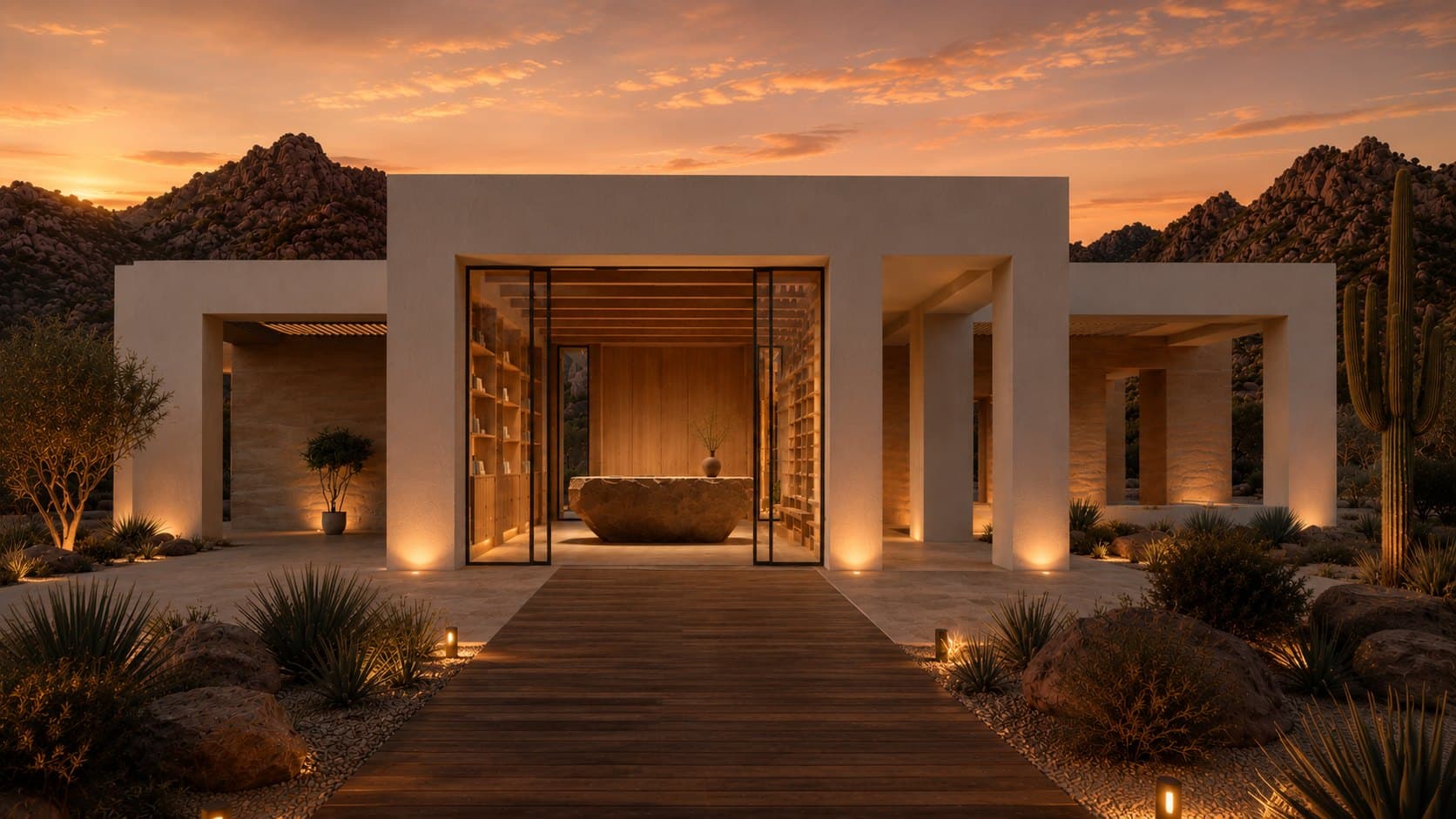
The way in, at dusk
(002) Why it matters
You are probably not underperforming because you are undertrained. Thirty-five hours awake raises the reactivity of your brain's threat-detection circuitry by sixty percent and cuts the prefrontal brake that normally sits on top of it — that is the mechanism behind the version of you that says the thing in the meeting and spends the next week walking it back. Chronic under-recovery is not a temperament problem either; it comes back on the panel as blood pressure, fasting glucose and a resting heart rate that will not come down, and evening light exposure is now implicated in all three. You are also a poor judge of your own recovery from the inside, which is why we measure it rather than ask you how you slept.
(003) The evidence
Grouped by how settled the evidence actually is, strongest first. Where the honest answer is we think so, and we are measuring it, the page says so.
StrongMeta-analysis, a replicated body of trials, or a large prospective cohort.
Ordinary room light in the hours before bed delayed melatonin onset in 99% of people and shortened the body's nightly melatonin window by about 90 minutes.
Gooley et al., J. Clinical Endocrinology & Metabolism, 2011In 2,315 Finnish men followed a median of 20.7 years, 4–7 sauna sessions a week versus one carried a hazard ratio of 0.37 for sudden cardiac death (95% CI 0.18–0.75), with the same direction for cardiovascular and all-cause mortality. This is a prospective cohort, so it establishes a dose-response association, not causation.
Laukkanen et al., JAMA Internal Medicine, 2015Across 47 trials and 3,515 participants, mindfulness meditation improved anxiety (SMD 0.38) and depression (SMD 0.30) at eight weeks against active controls — real and modest, and with no evidence it outperforms exercise or CBT.
Goyal et al., JAMA Internal Medicine, 2014
EmergingReal evidence, still thin — a single trial or a small literature.
Thirty-five hours without sleep produced 60% greater amygdala activation to aversive images than in rested controls, with roughly triple the volume of amygdala activated and a loss of the medial prefrontal cortex's top-down connection to it (n=26).
Yoo, Gujar, Hu, Jolesz & Walker, Current Biology, 2007Pooled across pain populations, massage therapy is strongly recommended against no treatment but only weakly recommended for pain, mood and health-related quality of life when compared against sham or other active treatments.
Crawford et al., Pain Medicine, 2016
What people get wrong
Renewal reads as the indulgent pillar — the massages, the fire, the part you are paying for while everything else is homework. It is close to inverted. The two 90-minute treatments carry the thinnest evidence on this page (massage beats no treatment easily and barely beats a convincing sham), while the strongest levers here are a dark hour before bed and a fixed lights-out — which cost nothing, are the reason the evening is built the way it is, and are the first two things you will drop in your first week home.
(004) How we score it
At intake we take resting heart rate and blood pressure, take the Flourishing Assessment’s Renewal questions, and pull the trailing thirty days off whatever you already wear — Whoop, Oura, Apple Watch — for overnight HRV, sleeping heart rate and sleep continuity. The same set repeats at departure and again at day ninety, and the flourishing items that sit alongside them are self-report, which we do not dress up as anything else. Treat your departure number with suspicion: five nights with no commute, no alcohol and no inbox will flatter anyone's overnight HRV, so the on-property reading is a ceiling rather than a result. The day-ninety number, taken in your own bed, is the one we publish and the one worth arguing about with your physician.
Intake, departure, and again at day ninety. The last one is the only one that tests anything — anyone can feel better on the drive home.
(005) The other six
- RhythmThe timing of your day, not the length of it.[→]
- NourishmentWhat you eat, when you eat, and who you eat with.[→]
- MovementWe score what your body can do, not what it burned.[→]
- ResilienceHow fast you come back, not how much you can take.[→]
- ClarityHow clearly you think, and how much of your thinking loops.[→]
- ConnectionMeasured in people you actually see, not in how you feel.[→]